

INTRODUCTION : DIGITAL EVENT MANAGEMENT SYSTEM MALAYSIA
MP Sport Fishing is a fast-growing organiser in Malaysia’s freshwater angling scene, known for attracting large crowds
to their signature “Game Keli” tournaments. As participant expectations for fairness, transparency, and smoother
operations grew, the organiser recognised the need to move beyond manual processes and adopt a modern, technology-driven
event management system.
To support their expansion from 1,000-pax events to a 20,000-seat tournament, MP Sport Fishing engaged us to build a
complete digital event management system — designed to streamline operations, reduce human error, and enhance participant
confidence. The solution includes online ticketing, digital seat selection, QR check-in, IoT-powered scoring, real-time
ranking, and a central admin web app capable of managing multiple kolam simultaneously.
Because this was the organiser’s first large-scale digital tournament and the budget was limited, the project was deployed
as a Proof of Concept (POC). The objective was clear: to discover which parts of the event can be safely
digitalised and which processes should remain manual or be improved in future phases.
While this case study focuses on a Game Keli fishing tournament, the same architecture and implementation approach are
applicable to any large-scale event organiser looking for a scalable, transparent, and data-driven event management system.
Challenge
MP Sport Fishing faced several challenges while preparing to scale their tournament operations from 1,000 to 20,000 participants:
- Newly Built Kolam Site:
The event venue was newly constructed and used for the first time, meaning seat layout, crowd flow, and on-ground
operations were untested. - Scaling From 1K to 20K Participants:
Existing manual processes were not suitable for handling a ten-fold increase in registrations, seating, and check-in,
especially across multiple ponds. - Limited Large-Event Experience:
As this was their first high-volume Game Keli event, the organiser needed stronger coordination and structured digital
workflows to keep operations under control. - Budget Constraints and POC Approach:
Due to financial limitations, the system was deployed as a Proof of Concept (POC), with selected
modules (such as POS) provided in simplified form for live testing instead of a full enterprise rollout.
These challenges highlighted the need for a scalable, transparent, and fully digital event management system to support
MP Sport Fishing’s first large-scale Game Keli tournament and to serve as a model for future high-volume events.

Solution
To address these challenges and support MP Sport Fishing’s expansion into large-scale tournaments, we developed a complete
digital event management system tailored for high-volume, multi-venue operations. The same framework can
be adapted for concerts, festivals, expos, sports events, and other large gatherings.
Digital Event Platform Development
- Online Ticketing & Registration:
Implemented a secure online system that allows participants to register, purchase tickets, and receive digital
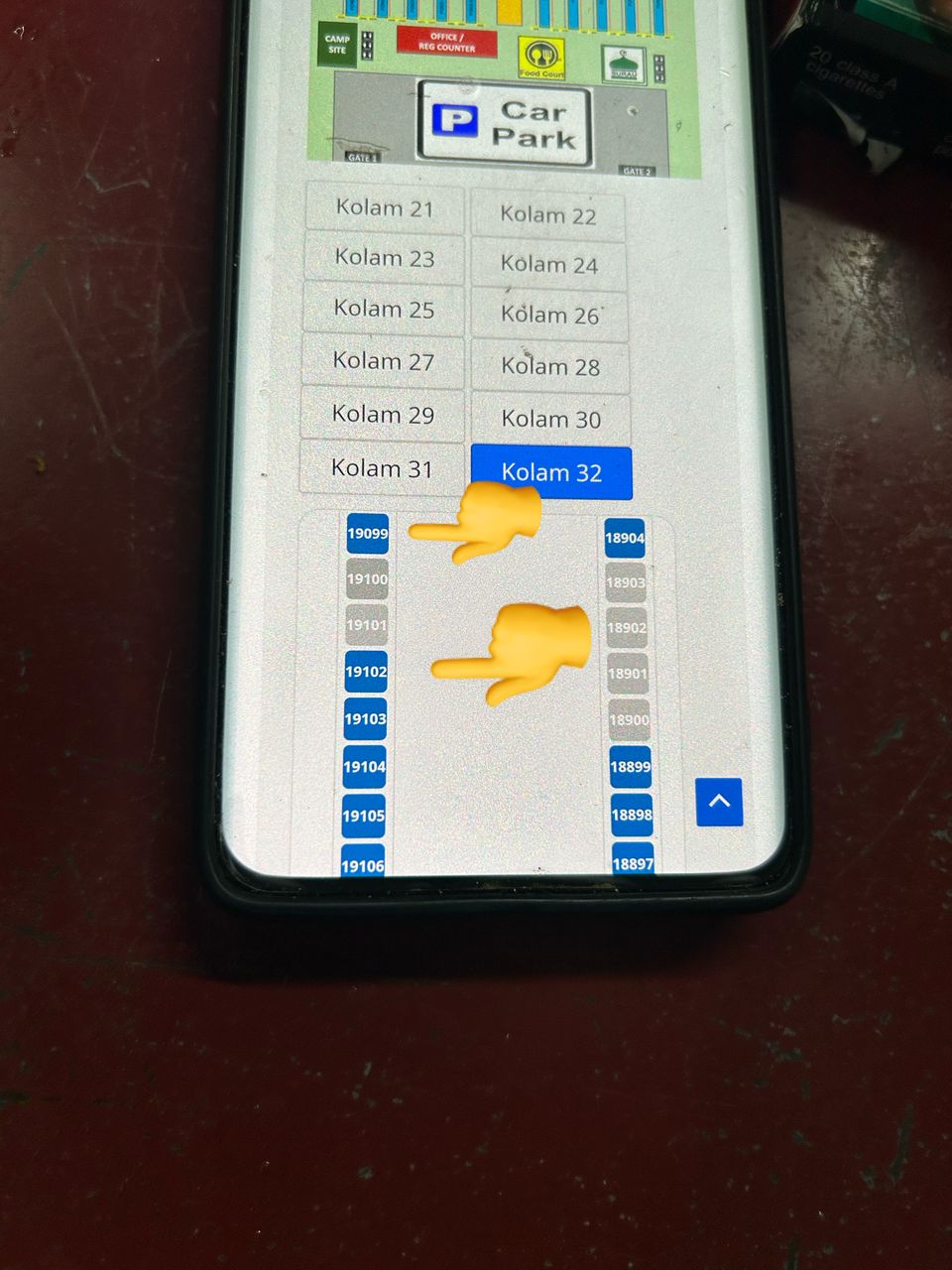
confirmations instantly, reducing manual paperwork and queue-based registration. - Digital Seat Selection:
Built an interactive seat mapping system capable of handling up to 20,000 seats across 30 kolam, preventing double
bookings and providing transparent seat allocation for both organisers and participants. - QR Check-In System:
Introduced a QR-based check-in flow with wristband printing to streamline entry, verify participant identity, and link
each attendee directly to their seat and registration record.
Real-Time Tournament Management
- IoT-Based Scoring:
Developed a real-time scoring module for marshals to submit fish weights, timestamps, and results digitally, replacing
manual scoring sheets and reducing human error. - Live Ranking Dashboard:
Enabled automated ranking and prize calculation, ensuring fairness, auditability, and faster result announcements for
both organisers and participants. - Multi-Role Admin Web App:
Created a central dashboard for admins, marshals, and ground staff to manage data, monitor submissions, oversee check-in
status, and track event activity in real time.
Operational Support & POC Deployment
- Proof of Concept (POC):
Due to budget constraints, key modules such as the POS counter were deployed in simplified form for live testing during
the event. This POC approach allowed the organiser to validate the concept before committing to a full-scale rollout. - On-Ground Coordination:
Provided system setup and workflow guidance so that the organiser’s team could begin operating the new digital processes,
while maintaining some manual steps where necessary. - Scalable Architecture:
Designed the platform to support future growth, enabling the organiser — and other large event owners — to scale smoothly
from 1,000 to 20,000+ participants with minimal structural changes.

Result
As a Proof of Concept (POC), the primary objective was not to deliver a final, fully polished system, but to test each
module under real event conditions and identify what works well digitally and what should remain manual or be refined
further.
- Online Sales Scaled Successfully:
The online registration and payment system was able to handle a large volume of bookings smoothly, confirming that
digital sales and pre-event registration can confidently replace manual sign-ups for future large events. - 20,000-Seat Selection Validated:
The digital seat selection module successfully supported up to 20,000 participants. After some initial hiccups during
the learning phase, the system stabilised and operated reliably throughout the tournament. - Clear Identification of Manual vs Digital Workflows:
The POC provided valuable insight into which processes can be fully automated — such as ticketing, seat allocation,
and scoring — and which still require on-ground manual coordination, especially for crowd movement and special cases. - POS Module Requires Further Training:
While functional, the POS system highlighted the need for more extensive staff training and event-day preparation to
ensure smoother usage in future events or in a full enterprise deployment. - Reliable Core System Performance:
Key components — digital seat selection, QR verification, IoT scoring, and real-time ranking — were validated under
real-world conditions, demonstrating strong potential for future full-scale deployment at larger or different types of
events.
Overall, this POC successfully achieved its main purpose: it allowed the organiser to test a digital event management system
in a live environment, discover which parts of the event can be confidently digitalised, and identify which workflows are
better kept manual or require more training. The same approach and system design can now be adapted and scaled for other
large event organisers in Malaysia seeking a reliable, transparent, and future-ready event management system.